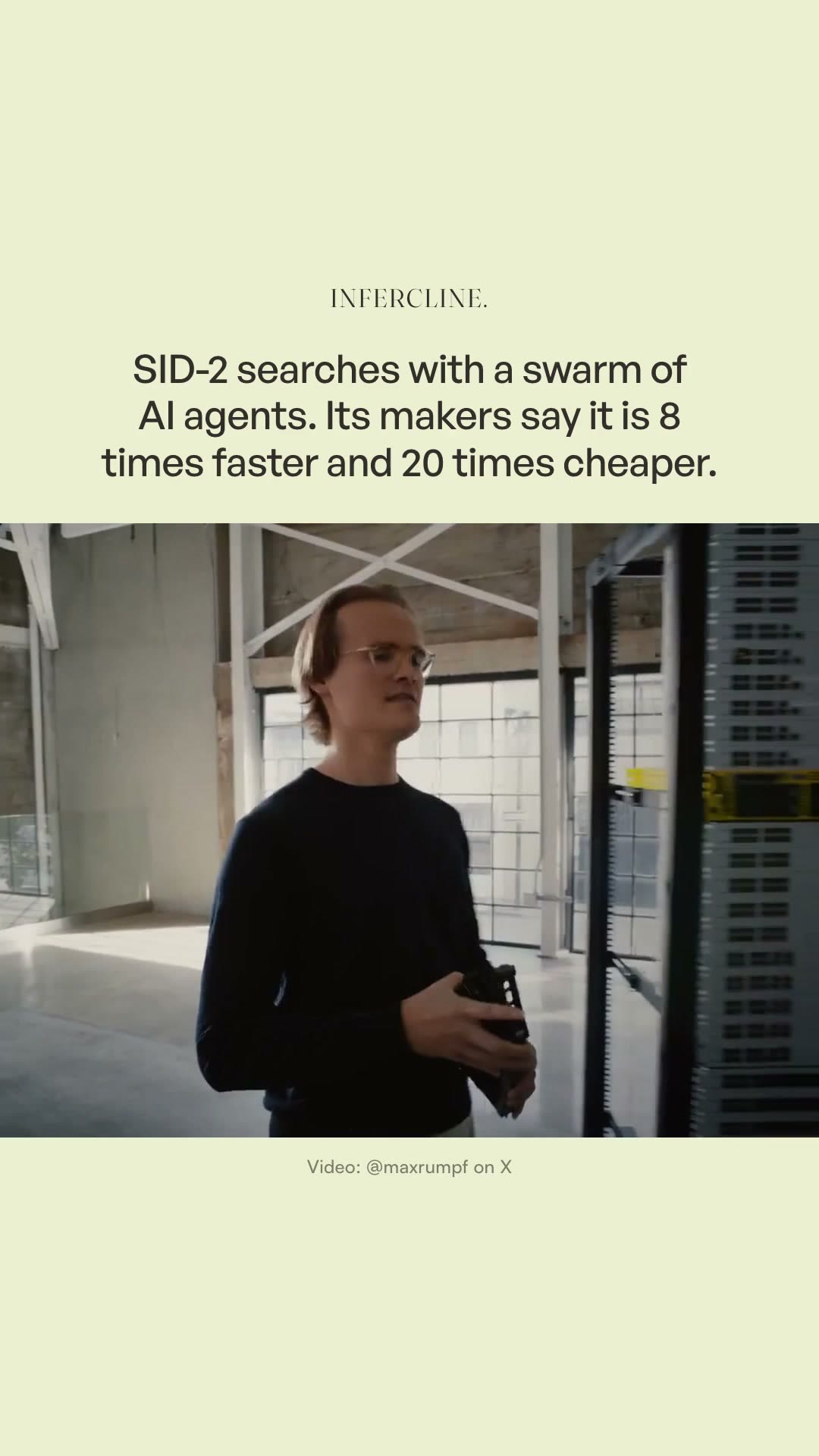
In the launch video, SID AI predicts that by 2030 AI will produce an internet's worth of text every day. It argues that today's search tools are rigid: they run a set routine written by people and hand back a fixed batch of answers, good or bad. Making general AI models bigger does not fix this, the video says, because the cost of reading each document rises with the size of the model.
SID's answer is SID-2, which it describes as a search model trained as a swarm. A single small search agent finds information in about 300 milliseconds, and SID-2 scales that up to dozens of agents running hundreds of searches. The video says the agents copy themselves, split up the job and work together to bring back the best matches. On its own hardest tests, the company says SID-2 beats Anthropic's Opus 5.5 while being eight times faster and 20 times cheaper. These are the company's own figures and have not been checked independently. It is offered through an API (the way other software plugs into it).
SID AI builds models for retrieval (finding the right information in a large pile of data), and the video was shared by Max Rumpf of SID. Emergent, which covered the launch, reports that SID-2 was released on 17 November through SID AI's API and that its benchmark results come from SID's own internal tests.
Why it matters to your business
Most business AI is only as good as what it can find. A chatbot answering a customer, or an assistant summarising a contract, depends on pulling the right page from your files first. If search like this becomes faster and cheaper, more firms can afford AI that answers from their own documents rather than guessing, and the gap between companies with tidy, searchable records and those without will widen.
There is also a cost lesson. SID's claim is that a group of small, cheap agents working together can match a much larger model on a narrow job. If that holds up in independent tests, owners will not always need the most expensive AI model to get good results, which lowers the price of putting AI to work on everyday tasks.
What to do in your business tomorrow
- Ask whoever runs your AI tools to show you, for five real questions, which of your own documents the tool found before answering, and fix any answer that cannot point to its source.
- Pick one folder of documents your team searches most, such as contracts or support notes, and clean up its file names and duplicates so any search tool can find the right page.
More on this topic: AI agent costs