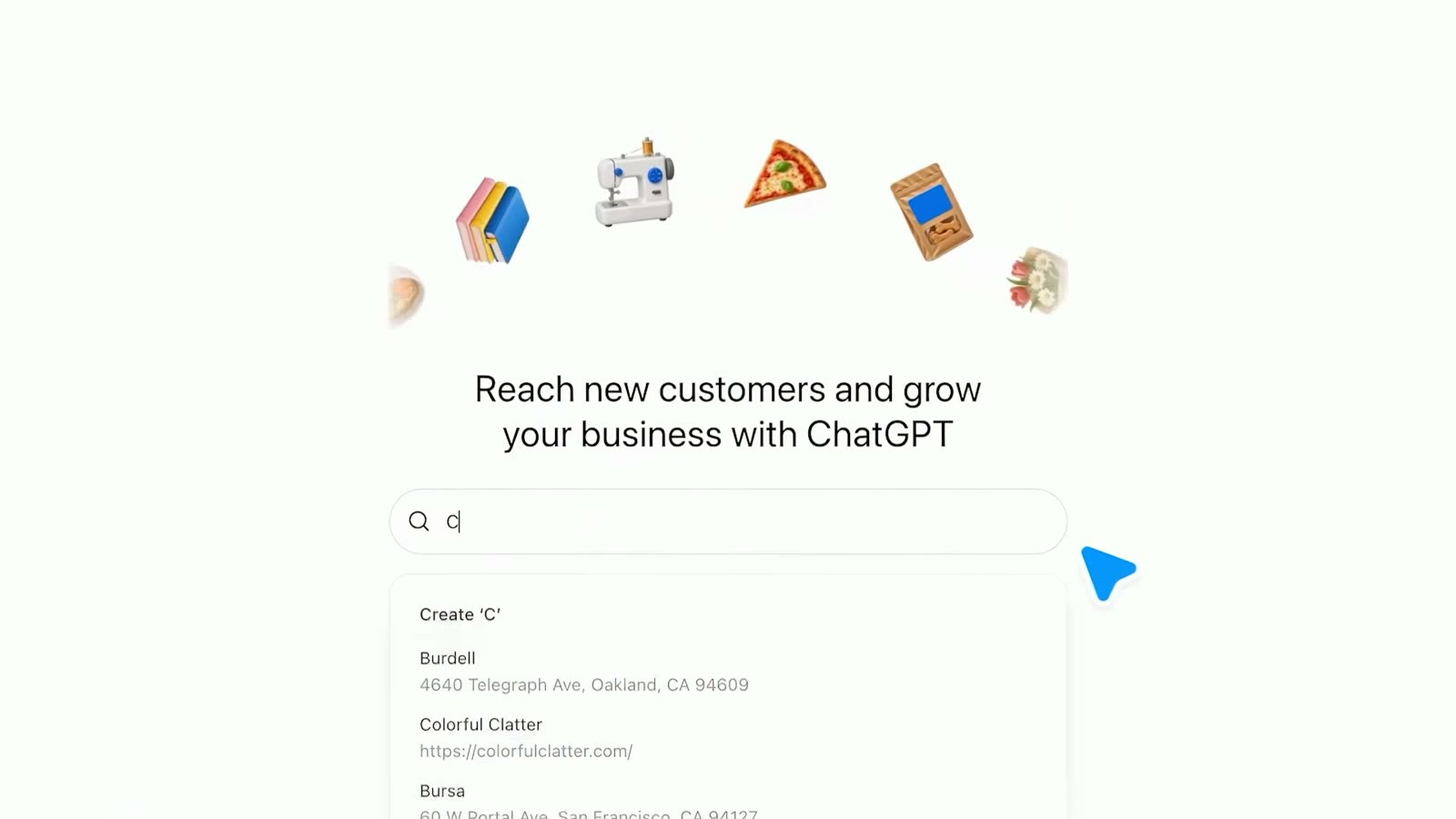
OpenAI has posted a short demo with no narration that shows how a business can claim its place in ChatGPT. In the video's own description, a merchant starts in OpenAI's Business Hub or in the Shopify App Store, connects the store directly to ChatGPT, and then manages its business information to shape how it shows up in ChatGPT. Shopify is the online store platform that many small and mid-sized retailers use to sell on the web.
The demo belongs to a wider beta (an early, test version of a product) called Businesses in ChatGPT. Dynamic Business reports that OpenAI confirmed the launch on 10 November 2026, built around a Business Hub where companies claim a profile, prove they are allowed to represent the business, and keep their details up to date. Both Dynamic Business and tbreak report that Shopify merchants can link their store from the Hub or from the Shopify admin to speed up that check, and that eligible Shopify products already appear in ChatGPT through the Shopify Catalog.
tbreak reports OpenAI's figure of 1.2 billion people using ChatGPT each week. The same outlets add a limit worth knowing: OpenAI says a claimed profile does not guarantee a higher position in ChatGPT's answers or more sales, and the assistant keeps making its own recommendations. Business Agents (a chat assistant a company can set up to answer customers inside ChatGPT) are, for now, only for eligible online shops and online service businesses in the United States.
Why it matters to your business
For two decades, being found online mostly meant ranking on Google and keeping a Google business listing tidy. More customers now ask an AI assistant what to buy or whom to use, and OpenAI has just opened an official way for a business to manage what that assistant says about it. Claiming a profile will not buy a better spot, by OpenAI's own account, but leaving it unclaimed means your hours, products and description come from whatever the AI finds elsewhere, which may be out of date or wrong.
The cost of acting early is small: Dynamic Business reports that claiming a profile is free, and for a Shopify shop the store connection does much of the proof of ownership. The risk sits with businesses that treat AI answers as someone else's problem. Competitors who keep their product details accurate give the assistant better material to work with, and a channel that is quiet today tends to become crowded and costlier once everyone notices it.
What to do in your business tomorrow
- Write down, this week, three questions a real customer might ask an AI assistant about what you sell, then try them and note whether your business appears and whether the details are right.
- Try the Business Hub search for your business name and see whether a profile already exists for it; if you sell on Shopify, have whoever runs the store look at the ChatGPT option in the Shopify admin.
- Fix the basics the assistant is likely to read first: your opening hours, prices and product descriptions on your own website.
More on this topic: AI agent guides
Sources
- OpenAI: How to claim your business in ChatGPT with Shopify
- Dynamic Business: OpenAI just made it free to claim your business a profile in ChatGPT, here's how
- tbreak: OpenAI launches Businesses in ChatGPT, starting in the US
- Fone Arena: OpenAI rolls out Businesses in ChatGPT with Business Hub and Business Agents