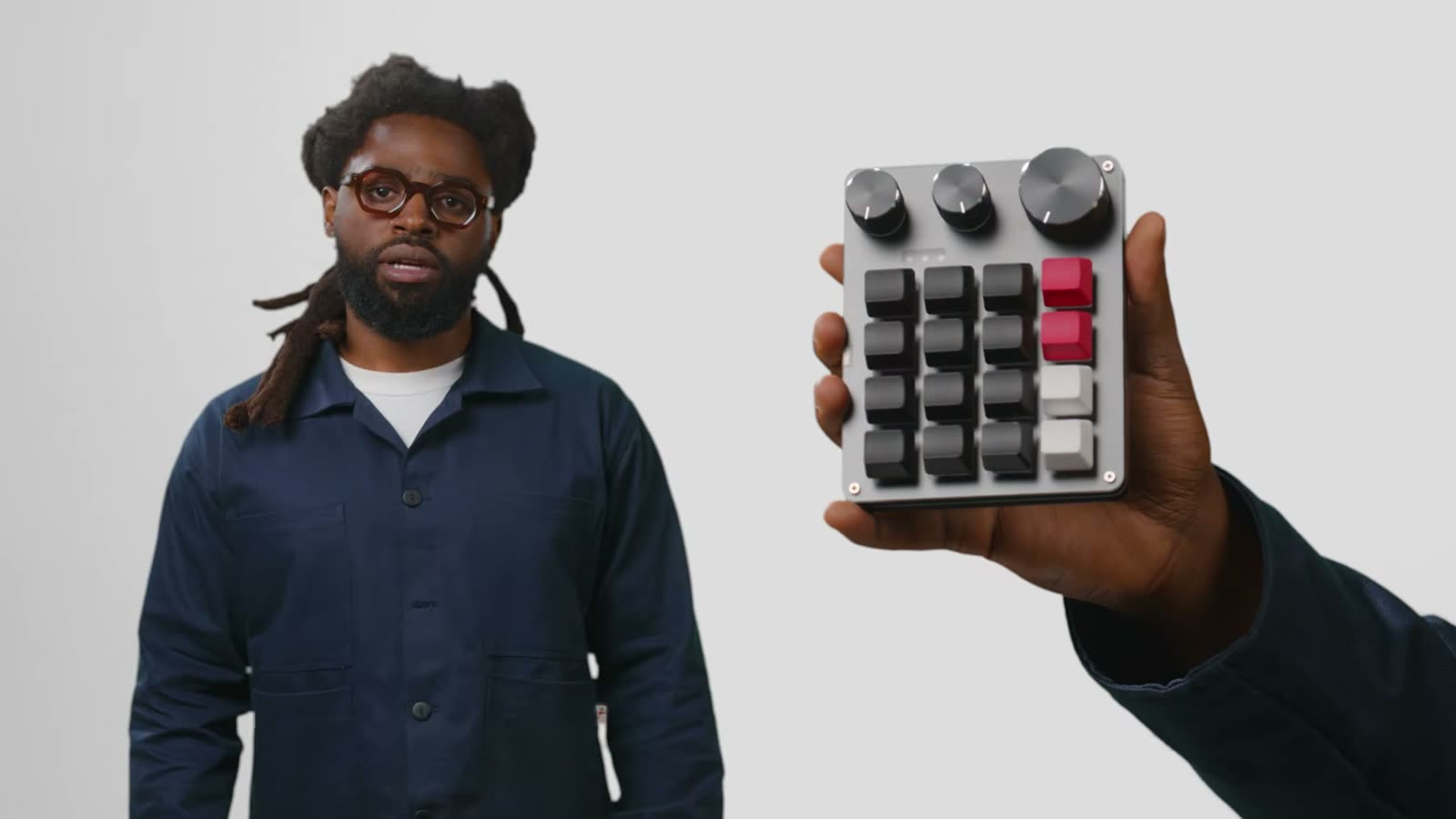
Arlander Taylor, described by Google as a music producer, DJ and pianist, bought a generic gaming macro pad (a small keypad normally used for computer shortcuts) online for $40. It has 16 keys and three knobs. He says he flashed it (replaced its built in software) and used Gemini 4 inside Antigravity, Google's tool for building software with AI, to turn it into "the custom synthesizer and groove box that I've always wanted".
Taylor describes the steps. He first asked the model to map the hardware, and on its first attempt it drew an exact copy of the pad on screen. He then steered the sound engine towards his own taste, adding layered rhythms, heavy kick drums and his own drum kits to the sequencer (the part that plays patterns in a loop), plus drones held in the musical key he wanted. Finally he linked reverb and other effects from his favourite studio gear to the three physical knobs. He says the music in the video was made on the finished box with Gemini 4 Carbon.
Gemini 4 Carbon is Google's newest frontier model (one of its most capable AI systems). A Google news site reported that it is rolling out to Google AI Ultra subscribers in the Gemini app, AI Mode and Antigravity, and that Google pitches it for complex, multi step coding and debugging, with a cheaper model, Argon, kept for most everyday work. Reuters, in a report carried by Khaleej Times, said Google built Carbon to handle complex, long running engineering and coding tasks, The launch price is $2 for every million tokens (small chunks of text) sent in, and $10 for every million that come back out.
Why it matters to your business
For years the expensive part of a custom product was the engineering, not the parts. In this demo a musician, not a software engineer, directed the whole build by describing what he wanted, and the hardware cost $40. That shrinks the cost of testing a niche product idea from months of developer time to something one person with domain knowledge can try in days.
That cuts both ways. If you sell specialist kit at a premium mainly because it is tailored, some customers may now build their own version from cheap generic parts. If you are the customer, the same shift means a tool your team pays heavily for might be replaced by an off the shelf device plus a few days of AI assisted work. Expertise in the job itself, here the musician's ear, becomes the scarce ingredient rather than coding.
What to do in your business tomorrow
- List one tool your team pays a premium for mainly because it is customised, and write down what a cheap generic version would still be missing.
- Give one person who knows a process well, not a developer, a day this week to describe a small internal tool to an AI coding assistant and see how far it gets.
More on this topic: AI agent costs